Connected manufacturing with PLM.
From design to delivery.
Connect engineering, production, and supply chain through a shared product record. Keep BOMs, changes, and manufacturing information in view across the lifecycle.
From engineering data.
To the production floor.
Bring the product information and the work around it into the same view. Explore six capabilities for connected manufacturing.
One product record.
Across disciplines.
Centralize BOMs, CAD data, and documents into one platform.
Design to production.
Keep the thread.
Connect design, manufacturing, and service in a continuous flow.
An evolving design.
A controlled change.
Manage engineering changes with full traceability and impact analysis.
Across CAD tools.
A connected context.
Seamlessly connect data across CAD tools and engineering systems without silos.
A shared view.
Across the supply chain.
Collaborate with global teams and partners seamlessly.
Product traceability.
From the start.
Maintain complete visibility into product data, ensuring compliance with industry standards and faster audit readiness.
Keep BOMs, CAD files, and multi-disciplinary product data together.
Review revisions, approvals, and the downstream work they affect.
Trace the product definition through production and service.
More disciplines.
One shared direction.
Manufacturers face rising product complexity, supply chain volatility, and tighter delivery schedules. Keep engineering, production, and quality connected as the work evolves.
Disconnected Systems
Engineering, production, and supply chain operate in silos, slowing decisions.
Rising Product Complexity
Multi-disciplinary products (mechanical + electronics + software) increase coordination challenges.
Supply Chain Volatility
Global disruptions demand real-time visibility and agility.
Pressure to Reduce Time-to-Market
Faster innovation cycles leave no room for inefficiencies.
Quality & Compliance Risks
Poor traceability leads to costly errors and recalls.
The product.
And the path to production.
Connect product and production data to support simulation, validation, and process improvement before execution. Follow four ways to put the digital thread to work.
Explore product data and manufacturing workflows
Smart Product Manufacturing.
Manage complex, multi-domain products with complete lifecycle visibility.
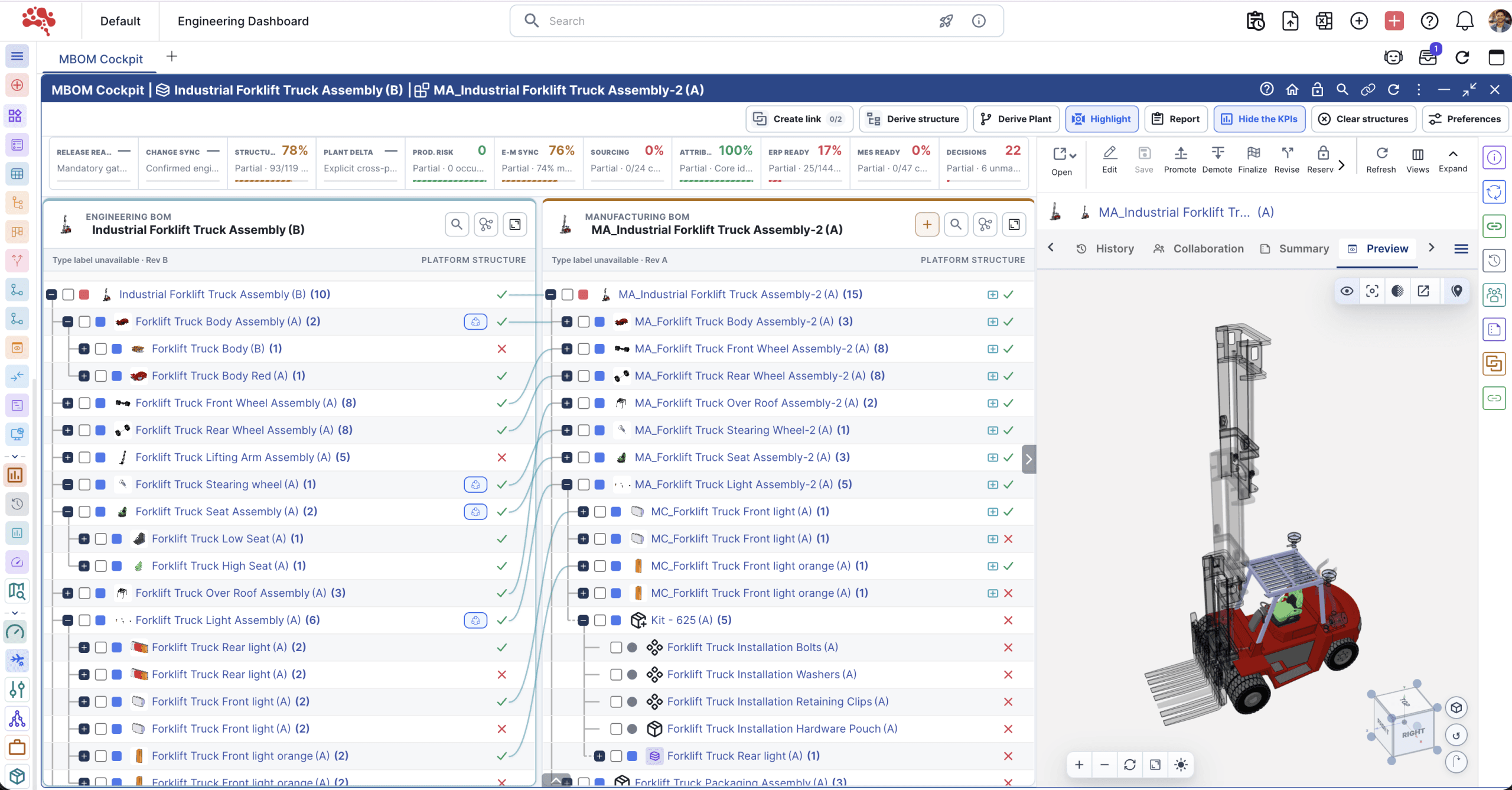
Manufacturing BOM & Process Synchronization.
Ensure alignment between Engineering BOM (EBOM) and Manufacturing BOM (MBOM) with real-time updates across design and production.
Change Management at Scale.
Ensure every change is tracked, validated, and implemented seamlessly.
Global Collaboration.
Enable distributed teams to work on a single, real-time platform.
Your manufacturing BOM.
Assembly to reporting.
Take a closer look at assembly creation and manufacturing BOM reporting in Nora IPLM.


Less disconnected work.
A clearer way forward.
Connect product data and workflows to improve efficiency, reduce operational risk, and keep lifecycle information in view.
Across daily operations
- Reduce prototyping costs
- Identify design flaws early
- Optimize production workflows
- Enable predictive manufacturing
Across the product lifecycle
- Faster Time-to-Market
- Reduced Operational Costs
- Complete Product Traceability
- Improved Engineering Productivity
- Seamless Cross-Functional Collaboration
The same product.
A connected way of working.
Bring the structure, the people, and the lifecycle record together instead of reconciling information across separate processes.
| Traditional approach | With Nora IPLM |
|---|---|
| Complex & slow to implement | Fast, intuitive, cloud-ready |
| Siloed data systems | Unified digital thread |
| Limited flexibility | Highly configurable |
| High cost of ownership | Scalable & cost-effective |
Built for smart manufacturing.
Keep the lifecycle connected.
Connect product design, engineering, and production processes through a digital thread. Give teams a shared context for collaboration and informed decisions.
Explore the live sandboxGet to know
PLM for manufacturing.
What to know before connecting your manufacturing lifecycle.
What is PLM and how does it help manufacturing companies?
Product Lifecycle Management (PLM) connects product data, processes, and teams across the entire lifecycle-from design to production and beyond. For manufacturers, this means improved collaboration, faster product development, better traceability, and reduced errors across engineering and production.
How does Nora IPLM improve time-to-market?
Nora IPLM streamlines workflows by unifying product data, automating change processes, and enabling real-time collaboration. This reduces delays caused by disconnected systems, helping teams move from design to production faster and more efficiently.
Can Nora IPLM integrate with existing engineering and ERP systems?
Yes, Nora IPLM is designed to integrate with your existing ecosystem, including CAD tools, ERP systems, and other enterprise applications.
Is Nora IPLM suitable for complex, multi-domain products?
Absolutely. Nora IPLM supports products that combine mechanical, electrical, and software components. It enables better coordination across disciplines, ensuring consistency, accuracy, and faster innovation for complex product development.
Your next product.
A connected lifecycle.
Bring engineering, operations, and supply chain together. Reduce complexity and keep your product information connected from design to delivery.