Smarter PLM.
Less complexity.
CIMdata examines how Nora IPLM connects product information, simplifies lifecycle work, and gives AI a governed foundation for analysis and decision support.
Read the original commentary
A perspective for small and midsize discrete manufacturers
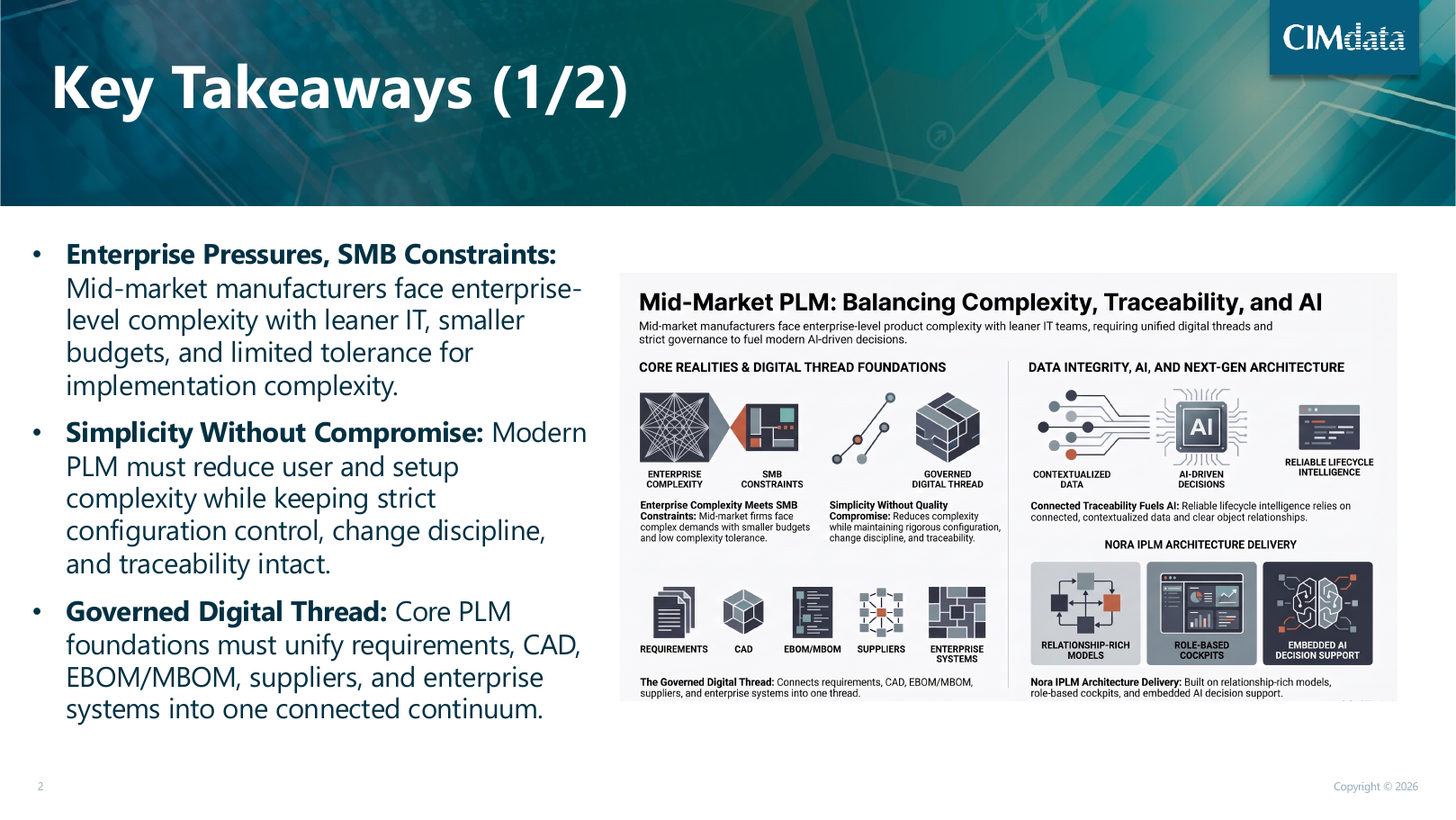
Small and midsize manufacturers face demanding configuration, quality, supplier, and delivery requirements. Yet their engineering and IT teams often have limited time and budget to deploy and administer PLM. CIMdata’s commentary starts with this practical tension: lifecycle capability has to fit the organization that will use it.
When CAD files, spreadsheets, email, shared drives, and ERP records hold different parts of the product definition, teams struggle to establish which information is current. Disconnected records slow changes, encourage duplicate entry, and obscure the consequences of decisions downstream.
For CIMdata, making PLM simpler means removing avoidable effort from deployment and everyday work while keeping configuration, approval, revision, and traceability controls intact. Ease of use must extend access to those controls, rather than weaken them.
The product context has to stay connected.
CIMdata describes a modern PLM foundation as a governed network of product information. Requirements, items, designs, documents, engineering and manufacturing BOMs, configurations, changes, projects, issues, and suppliers need relationships that teams can follow across disciplines.
Traceability across the lifecycle
A digital thread makes upstream and downstream dependencies visible. It gives a change its product context: what was altered, the reason, affected configurations, required approvals, implementation progress, and consequences for other teams.
Continuity into manufacturing
Engineering and manufacturing structures must remain connected as options and variants multiply. Maintaining those relationships reduces the need to recreate information manually when translating an engineering definition into a production structure.
Relevant information for each role
People need the actions, status, and exceptions relevant to their work. Focused experiences should draw on the shared product model without requiring every participant to understand its entire structure. Connections to enterprise systems must also prevent PLM from becoming another silo.
Manageable deployment and administration
The foundation must also be sustainable for a smaller organization. CIMdata emphasizes reducing infrastructure, custom code, upgrade effort, and dependence on specialist administrators, with configurable processes and low-code or no-code tools where appropriate.
How Nora IPLM puts that foundation to work.
The commentary examines Nora IPLM as an emerging, cloud-native platform developed by Cerebital for small and midsize discrete manufacturers. It brings product structures, requirements, documents, revisions, configurations, changes, workflows, projects, collaboration, analytics, and AI into one environment.
A product model built around relationships
CIMdata describes a model with more than 50 object types and over 100 defined relationship types. Users can move between related product records instead of piecing together information from disconnected tools. Configurator capabilities cover models, features, options, effectivities, and occurrences; the commentary also notes continuing expansion of MBOM capabilities.
Cockpits that connect information and action
Composable workspaces combine data, relationships, analytics, workflows, and actions for a role or process. The Change Cockpit, for example, connects requests, orders, tasks, and affected product information. Reusable workflow templates, assigned tasks, parallel execution, branch and merge policies, and linked deliverables keep responsibilities and outcomes tied to the product context.
Trustworthy AI starts with trustworthy product context.
CIMdata treats the digital thread as a prerequisite for useful lifecycle intelligence. Search, summarization, dependency analysis, and change-impact assessment need authoritative structures, configurations, and histories. AI cannot make disconnected or unreliable product information trustworthy on its own.
In Nora IPLM, Prima combines an embedded assistant with domain-specific agents. The commentary describes demonstrated impact analysis across related items, issues, suppliers, drawings, and other objects, including evaluation of cost and weight alternatives. It presents more autonomous, specialized workflows as a direction for expansion.
The commentary also describes opt-in AI, customer data isolation, and supported model choices including OpenAI and Google Gemini. These controls give organizations a way to govern how AI uses proprietary engineering information while drawing on connected lifecycle context.
Openness beyond the PLM platform.
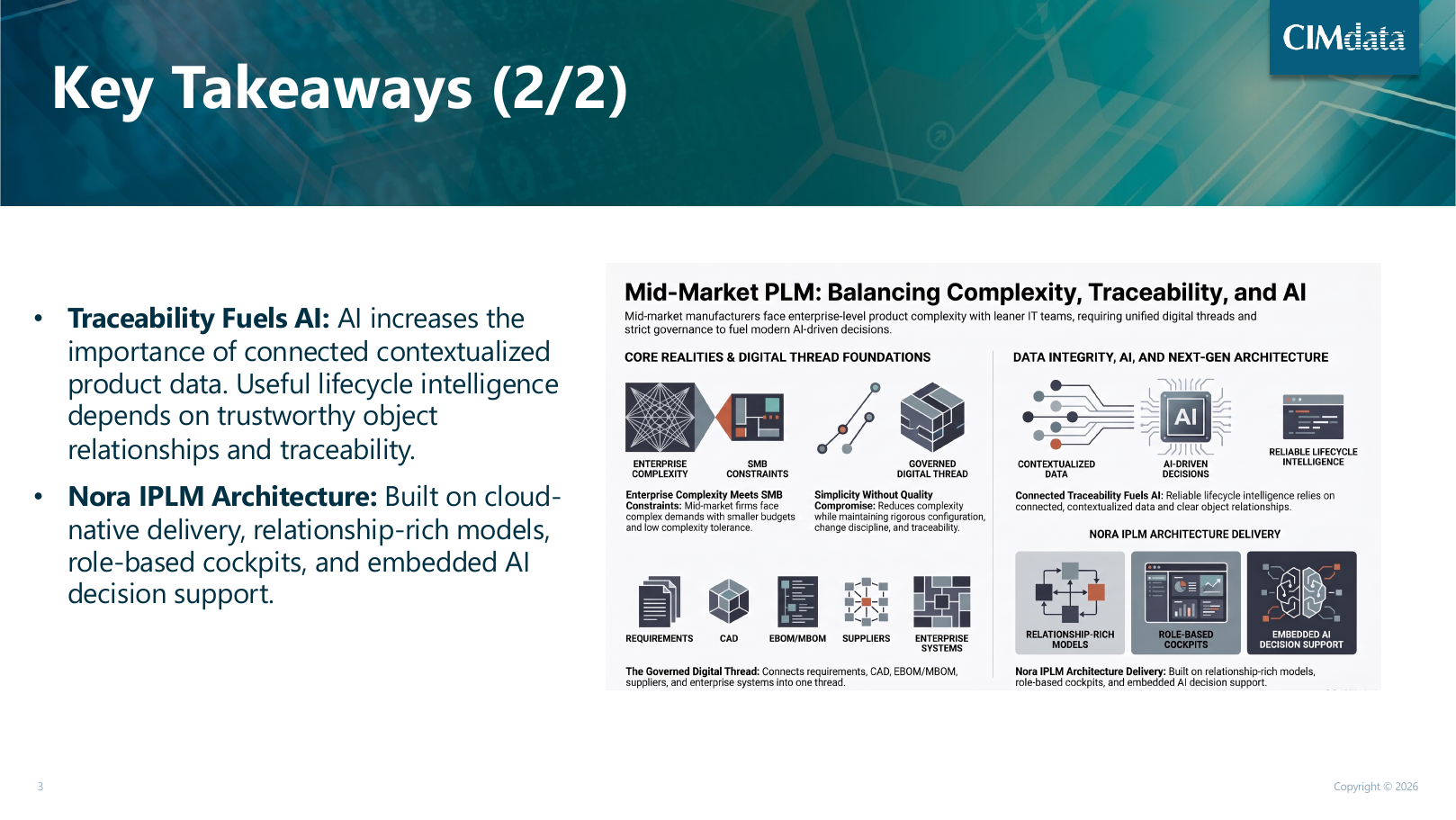
Connected product work extends into design tools, business applications, and supplier environments. The commentary identifies live Nora integrations with CAD, Microsoft Office, Jira, and GitHub, alongside APIs and webhooks. SAP, Oracle NetSuite, and custom ERP integrations are described as available on request.
Nora’s MCP server provides another route for compatible applications and AI services to work with governed product information. CIMdata frames this openness as part of an emerging ecosystem built around product context, rather than isolated AI interactions.
CIMdata’s assessment of Nora IPLM.
The commentary sees Nora’s combination of connected lifecycle information, cloud-native delivery, focused workspaces, open integration, and AI analysis as a credible approach to making PLM easier to adopt and use while preserving lifecycle discipline.
“CIMdata is impressed with Nora IPLM’s capabilities.”
CIMdata · October 2026 commentary
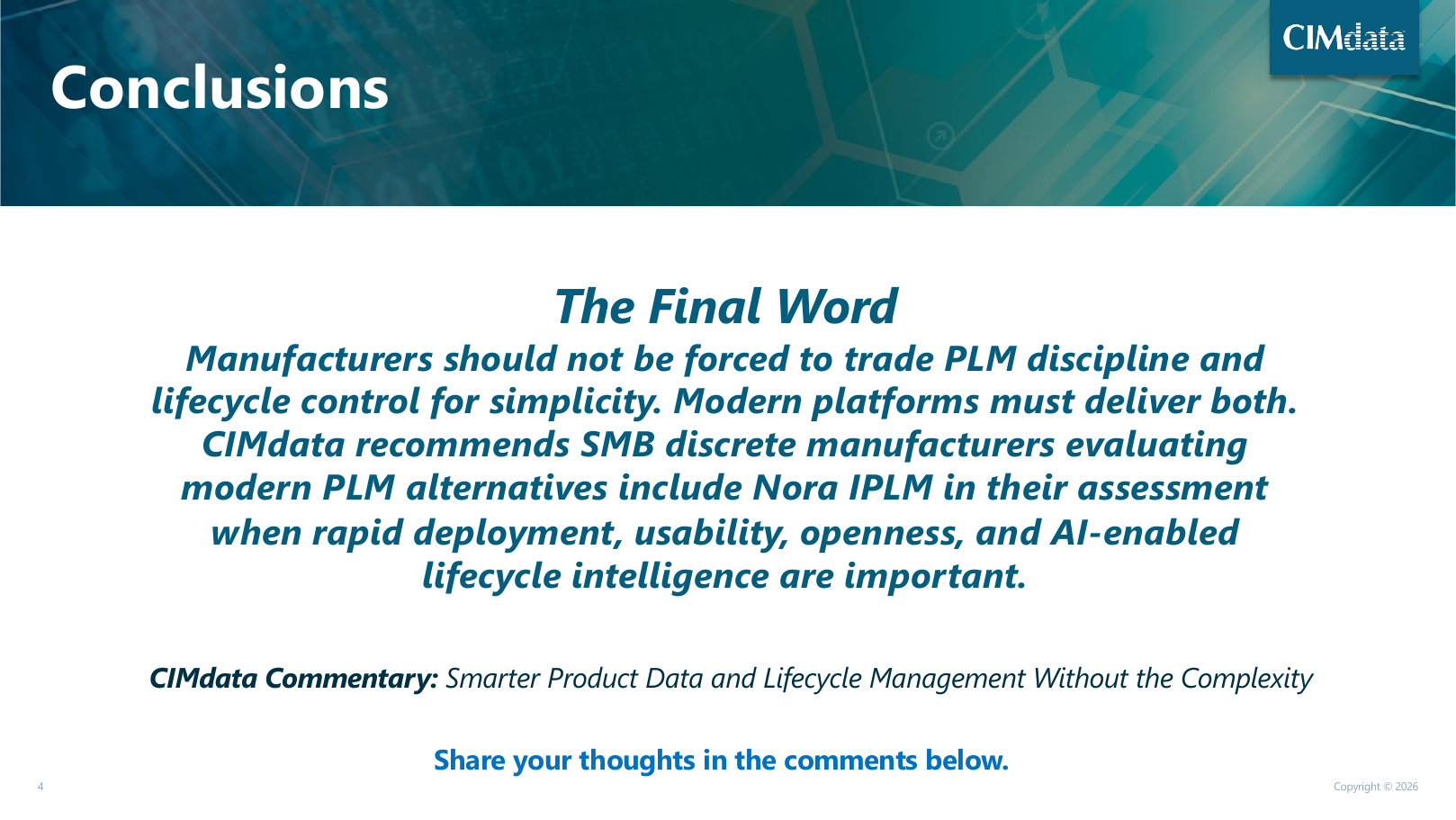
CIMdata recommends including Nora IPLM in evaluations by small and midsize discrete manufacturers when rapid deployment, usability, openness, and AI-enabled lifecycle intelligence matter.
Read the original research